
Haralson County Arrest Records and Court Charges
Haralson County arrest records are created on the law-enforcement side first. The sheriff's Detention Division receives people arrested for felonies and misdemeanors, processes admissions and releases, maintains security, and transports inmates for court or medical needs. Sheriff reception is the public point for warrants, bonding, and release, so a person checking a recent arrest often begins with the Haralson County Sheriff's Office rather than the courthouse. That booking side can show who was taken into custody, what agency handled the arrest, what charge was booked, and whether bond or release information is available.
The court charge record is different. After arrest, the District Attorney or another prosecutor decides what formal charge should be filed. In Haralson County, the Clerk of Superior Court files and processes warrants, indictments, accusations, and sentences for felony and misdemeanor cases. Magistrate Court handles warrant applications and bond hearings. Probate Court hears misdemeanor traffic, game and fish, and drug cases because Haralson County has no State Court. City municipal courts may hold city traffic or ordinance matters. For custody detail, use the Haralson County inmate records path; for the full case file and final outcome, use Haralson County criminal court records.
The sheriff's Detention Division page is the source for local booking, warrant, bond, release, inmate-search, and VINE context.
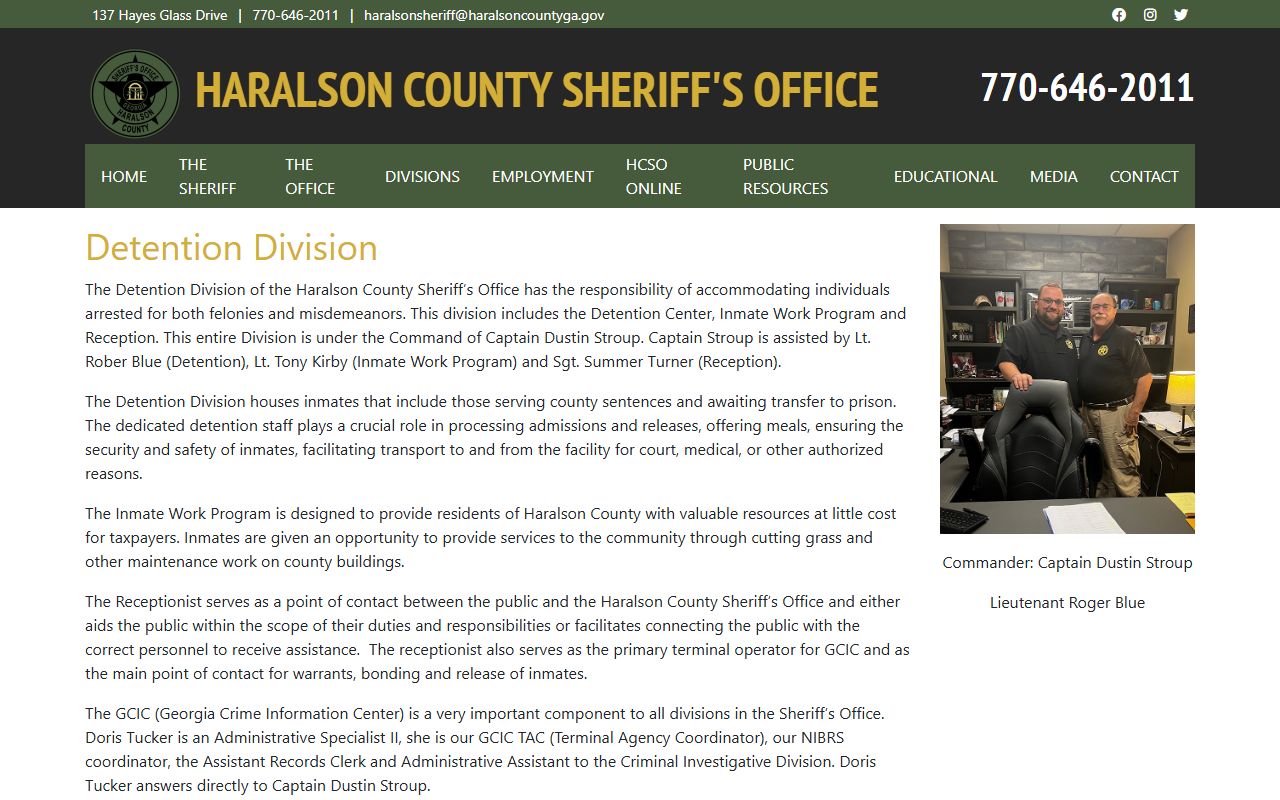
That detention source is important because an arrest can exist before any accusation, indictment, plea, disposition, or sentence appears in the court file.
Search Haralson County Arrest Records
A complete Haralson County arrest records search uses more than one official channel. Recent booking, release, and bond questions run through sheriff reception. Filed charges, indictments, accusations, sentences, and docket entries run through the Clerk of Superior Court or the court that owns the case. The statewide re:SearchGA court-record portal is an online court-search channel, but the research capture could not inspect the full live Haralson public view. If the portal requires an account or does not show the case, contact the custodian directly.
- Start with the arrest side. Call sheriff reception at 770-646-2011 for booking, bond, warrant, and release questions that are not clear online.
- Identify the court path. Felony charges usually route to Superior Court, Magistrate Court may handle warrant applications and bond hearings, Probate Court handles certain misdemeanors, and city matters may stay municipal.
- Search re:SearchGA or ask the Clerk of Superior Court for filed accusations, indictments, warrants, sentences, and docket entries if the case is in Superior Court.
- For a pending-trial case, follow the sheriff's discovery caveat and contact the Clerk of Superior Court or counsel about proper discovery motions.
State-level criminal-history tools are separate from Haralson County charge files. The sheriff provides local Georgia criminal-history reports for defined purposes, and Georgia Felon Search is a statewide criminal-history path. Those reports do not replace the court file, and they do not prove that every booked charge became a conviction.
Haralson County Charges Filed After Arrest
Court charges after arrest begin when the case moves from booking facts to a filed charging document. Haralson County research confirms that the Clerk of Superior Court processes criminal warrants, indictments, accusations, and sentences. The District Attorney represents the State of Georgia in felony cases, juvenile delinquency matters, and misdemeanor cases in counties without State Court, including Haralson. A booking charge can be a starting label. The filed court charge is the accusation, indictment, warrant-linked charge, or other court filing that the prosecutor and court use as the case moves forward.
| Charging paper | Haralson County use | What to confirm |
|---|---|---|
| Complaint or warrant application | May appear around the arrest, first appearance, warrant application, or Magistrate Court stage. | Issuing court, date, alleged offense, bond setting, and whether a later filing replaced or changed it. |
| Accusation | A prosecutor-filed charge document processed by the Clerk of Superior Court for criminal cases. | Defendant name, charge text, O.C.G.A. code if listed, filing date, and current status. |
| Indictment | A grand-jury charging document used in Superior Court felony practice. | Count numbers, offense levels, amendments, dismissals, plea, sentence, or appeal record. |
A single arrest can produce more than one count. It can also produce no final conviction. That is why charge status, disposition, and sentence should be read separately.
Haralson County Charge Status
Charge status can change as the case moves through court. A first booking label may not match the final accusation, indictment, plea, disposition, or sentence. The expected public case fields in the research include case number, court, filing date, defendant, offense or charge, warrant or accusation reference, judge, attorney, plea, disposition, sentence, probation, bond, financial obligations, hearing dates, docket entries, and appeal references. If one of those fields is missing online, the clerk or court custodian is the better source than a third-party name search.
| Status | What It Means |
|---|---|
| Pending | The charge is still open, or no final public disposition was confirmed in the available court record. |
| Amended or reduced | The charge text, count, level, or statute reference changed after filing. |
| Dismissed | The court record indicates the charge did not proceed to conviction in that case. |
| Nolle prosequi | The prosecutor did not pursue that charge, often shown as a dismissal-type disposition. |
| Sentence entered | The case has moved beyond charge filing into disposition and sentence records. |
Note: A charge can remain visible in a case file even when the outcome is dismissal, amendment, or record restriction.
Haralson County Charge vs Conviction
Being charged in Haralson County is not the same as being convicted. A charge is the State's allegation. A conviction is a final result after a guilty plea, verdict, or other qualifying disposition. The distinction matters for employment, housing, licensing, bond questions, and record restriction. A sheriff booking entry, warrant reference, or accusation may show why a person was taken into custody or brought to court. It does not prove the final outcome unless the court record also shows a plea, verdict, disposition, sentence, or probation term.
| Charge | Conviction | |
|---|---|---|
| Stage | Arrest, warrant, accusation, indictment, or pending court count. | Final plea, verdict, or sentence stage in the court file. |
| Record source | Sheriff, Magistrate Court, Clerk of Superior Court, Probate Court, or municipal court. | Usually the court file and any official criminal-history report that lawfully includes it. |
| Meaning | An allegation or filed count that may change. | A final adjudicated result, subject to appeal or later restriction in limited cases. |
Restricted Haralson County Charge Records
Georgia public-facing practice often uses the term record restriction rather than expungement. Under O.C.G.A. 35-3-37, eligible criminal-history information may be limited from public dissemination after the proper process. Juvenile records, adoption records, sealed matters, mental-health matters, protected victim information, Social Security numbers, financial account numbers, and minor identifying details may also be withheld or redacted. Eligibility depends on the arresting agency, charge, disposition, and court order where required.
| Record restriction | Public court file | |
|---|---|---|
| Visibility | Public dissemination may be limited for eligible records. | Public unless a statute, order, or redaction rule limits access. |
| Typical basis | Dismissal, non-prosecution, acquittal, or another qualifying outcome. | Open criminal, civil, probate, warrant, or traffic record held by the custodian. |
| Where to start | Identify the arresting agency, case, and disposition before filing any request. | Ask the Clerk of Superior Court, Probate Court, Magistrate Court, municipal court, or sheriff. |
Haralson County Charge Codes
Haralson County charge codes should be read with the court level. Superior Court is the primary general-jurisdiction trial court and handles felony criminal cases. Probate Court handles misdemeanor traffic, game and fish, and drug cases in Haralson because there is no county State Court. Magistrate Court is tied to warrant applications, bond hearings, bad-check matters, county ordinances, and lower civil or criminal proceedings. Municipal courts in Bremen, Buchanan, Tallapoosa, and Waco may hold city ordinance and city traffic cases. The same event can involve booking, a warrant, a bond hearing, a prosecutor-filed accusation or indictment, and later sentencing.
For charge codes, look for the offense text, O.C.G.A. statute if shown, count number, court, filing date, and disposition. If a case has several counts, each count should be checked separately. One charge may be dismissed while another is reduced, amended, or sentenced.
Haralson County Criminal History Checks
The sheriff's criminal background checks page describes local Georgia criminal-history reports for employment checks, firearms permit applications, guardianship cases, immigration cases, and personal review. A lifetime self-report can include complete adult misdemeanor and felony Georgia history. A report on another person is limited to complete adult felony Georgia history. The fee is $20, payable by cash or money order only, and the requester must present valid Georgia photo ID. For another-person request, the sheriff asks for full name, date of birth, and Social Security number if possible.
That background-check source helps explain why a Haralson County arrest records search is not the same as a court-charge search.
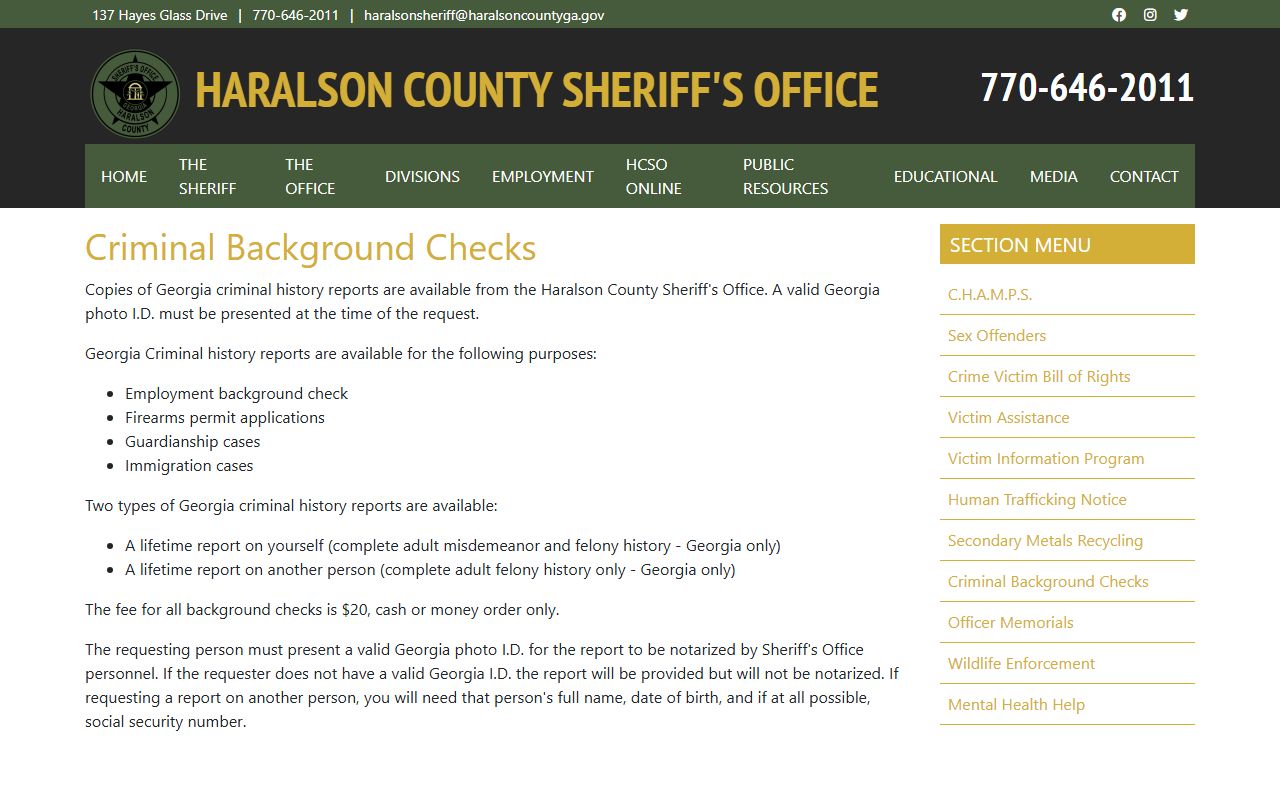
A criminal-history report may summarize eligible statewide history, while the court file shows how a specific Haralson County charge moved through court.
Haralson County Background Checks
Use official records for official decisions. Open court searches, sheriff background checks, and state criminal-history systems can have different legal uses and different limits. The sheriff's open-records page also warns that people and attorneys seeking information about a pending-trial case may need to contact the Clerk of Superior Court and file proper discovery motions. That is a stronger rule than a general public-record request when discovery law controls the material.
Important: Verify charge status, restriction status, and conviction status with the official custodian before relying on a record.
Public Access Limits
Georgia's Open Records Act generally makes public records available for inspection and copying unless a specific exemption applies. Agencies may charge lawful search, retrieval, redaction, and copy fees under O.C.G.A. 50-18-71. Haralson County users should begin with the office that holds the record: sheriff for arrest, incident, bond, release, and background-check records; Clerk of Superior Court for accusations, indictments, sentences, appeals, and Superior/Juvenile filings; Magistrate Court for warrant applications and bond hearings; Probate Court for local misdemeanor traffic, game and fish, and drug matters; and municipal court for city cases.
Some records are not open in the same way as an ordinary adult criminal case. Juvenile matters are subject to separate confidentiality rules. Adoption files are restricted. Mental-health and involuntary hospitalization materials are sensitive Probate Court matters. Protected identifiers and victim information may be redacted. Pending investigations, sealed warrants, and discovery-controlled criminal materials may also be withheld from a public request.